APIDevTools JSON Schema Ref Parser is a popular JavaScript library, available as an npm package, used to parse, resolve, and dereference JSON Schema $ref pointers. It is often referenced by its package name, @apidevtools/json-schema-ref-parser, or simply json-schema-ref-parser.
It helps developers combine multiple JSON schema files into one fully resolved schema that can be easily validated or used in an application. This package simplifies handling modular JSON structures.
In simple words:
- 👉 It reads your JSON Schema (and can json parse the contents).
- 👉 Finds all $ref links (ref pointers), which are also called schema ref.
- 👉 Replaces them with real schema data.
- 👉 Returns one complete, final schema.
Why APIDevTools JSON Schema Ref Parser is Essential
JSON Schemas often become large and are split into multiple files for modularity and maintainability. They use the $ref keyword (ref) to link to other schema parts:
JSON
{
  "$ref": "./user.schema.json"
}
Node.js alone cannot resolve these ref pointers automatically—the json-schema-ref-parser from APIDevTools does this complex work for you. Utilizing this npm package is a best practice in modern API development.
Key Capabilities of the JSON Schema Ref Parser Package
The @apidevtools/json-schema-ref-parser offers three core functionalities:
1. JSON Parse and Resolve $\text{\$ref}$ Pointers (Schema Ref)
The tool first performs a json parse (reading the structure) and then attempts to resolve all ref pointers (schema ref). It handles:
- Local references within the same file.
- External files (local directory).
- Remote URLs (web resources).
- Nested references (where one ref points to another ref).
2. Dereference JSON Schema (Dereference JSON)
The dereference function is the most commonly used, performing the final action of replacing all $\text{\$ref}$ values with the actual content they point to. This creates one complete schema with all $ref values replaced. The result is a single, self-contained JSON object—great for downstream validators like AJV, as they prefer a fully expanded schema.
3. Package and Latest Version Information
This package is actively maintained by the APIDevTools community. Developers should always check the latest version on npm to ensure they have the most secure code and benefit from the latest features and security fixes against potential vulnerabilities.
Basic Example and Use Cases
🛠️ Example Code (Dereference JSON)
By calling the dereference method from the json-schema-ref-parser, you get the final, flattened schema:
JavaScript
import $RefParser from "@apidevtools/json-schema-ref-parser";

// The latest version is found on npm
const schema = await $RefParser.dereference("schema.json");
console.log(schema);
// Result: A fully expanded schema with no $refs.
📌 Common Use Cases for the Ref Parser
The ref parser is fundamental in several areas:
- API development: Processing OpenAPI / Swagger schema definitions.
- JSON schema validation: Preparing large schemas for validators like AJV.
- Building forms from schema: Ensures the form builder has a single, complete schema definition.
- Merging multiple schema ref files automatically, reducing manual work and errors.
Conclusion
The APIDevTools JSON Schema Ref Parser is a powerful npm package that simplifies the management of complex, modular JSON Schema structures by efficiently resolving and performing dereference json on all $ref pointers. It is a crucial tool in modern API development, providing clean, ready-to-use schemas for validation and documentation systems.
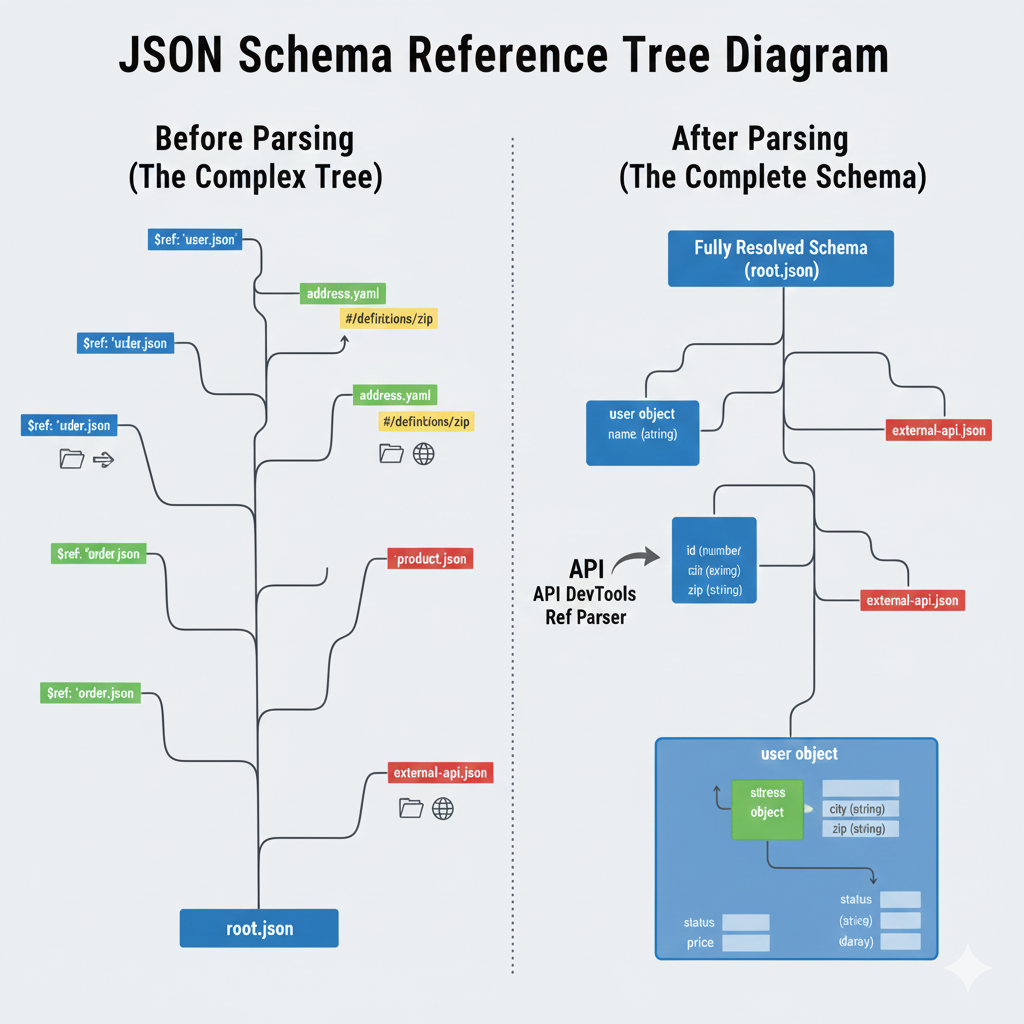
Content for the “JSON Schema Reference Tree Diagram”
This infographic illustrates the function of the API DevTools Ref Parser by showing how it converts a complex, fragmented JSON Schema (OpenAPI/Swagger) into a single, resolved file, which is essential for validation and documentation.
Title: JSON Schema Reference Tree Diagram
The diagram is split into two parts: Before Parsing (The Complex Tree) and After Parsing (The Complete Schema).
1. 🌲 Before Parsing (The Complex Tree)
This side shows the initial, fragmented state of a JSON Schema document where the root schema (root.json) relies on many external and internal references ($ref).
- The central document is the
root.jsonfile. - It contains numerous pointers (
$ref) to other files and paths, such as:$ref: 'user.json'(referenced multiple times)$ref: 'order.json'(referenced multiple times)- References to the contents of external YAML files (e.g.,
address.yaml#/definitions/zip). - References to other resources like
product.jsonandexternal-api.json.
- This structure is highly coupled and difficult to validate or read directly, as the schema content is scattered across many files.
2. ✅ After Parsing (The Complete Schema)
This side shows the output of the API DevTools Ref Parser after it has resolved all the references, resulting in a single, cohesive schema.
- The output is the Fully Resolved Schema (
root.json). - All the
$refpointers have been replaced by the actual content of the schemas they referred to. - The final structure is now ready for use and shows a clear hierarchy, including:
- A
user objectcontaining fields likename(string) and nested objects. - Data types are clearly defined (e.g.,
id(number/string),zip(string)). - Complex nested objects, like the
address object(containingCity(string) andzip(string)), are fully embedded within the user object.
- A
- The entire schema, even content from external API files, is now consolidated into one document, simplifying API consumption and validation.
Leave a Reply